
The power of collaboration in informal care
The accessibility and sustainability of healthcare is under pressure due to the aging population and shortages of healthcare personnel. This means greater demands on informal caregivers. In Twente, informal care is an essential part of the culture and healthcare infrastructure. For many people, caring for a loved one is a valuable and rewarding task. But informal care is also under pressure. The number of people who can provide informal care is expected to decline, and combining informal care with a working life can be challenging. The Informal Care Collaboration project is conducting research into how the cooperation between informal caregivers themselves and between employers and their employees who are informal caregivers can be strengthened.
Research-based design
Little is known about how informal caregivers can offer each other more support and what their needs are. There are also no known formal or informal interventions that can strengthen mutual cooperation. “That is why Saxion University of Applied Sciences, the University of Twente, and Twentse Koers, along with informal caregivers and employers, are going to conduct research,” explains Angelique Tinga, a researcher at Saxion. “It is research-based design, which means that we will work in steps from understanding the problem to finding a suitable solution for that problem. The informal caregiver and his or her needs are central to the entire process. The research is not only being conducted for the informal caregiver, but also with the informal caregiver. In this way, we will come up with a solution that actually suits the informal caregiver and can make a real contribution.” A more optimal deployment of informal caregivers can contribute to postponing the use of expensive and scarce professional care and can support the well-being of working or studying informal caregivers. “This also helps to limit the use of labor in regular care and additional (higher) costs,” says Astrid Boudrie, project leader at Twentse Koers.
Example
“We know of neighborhoods where there are often several informal caregivers,” says Astrid. "They usually visit their loved ones with the same goal in mind: to keep an eye on them, help with small daily tasks, and give them genuine attention. It would be great if these kinds of tasks could be shared, so that the burden could be spread out and everyone could support each other in providing care for longer. If informal caregivers can provide care for longer with this kind of support, older people can continue to live in their own environment for as long as possible. We know from previous research that there is a large amount of ‘untapped care capacity’ in society. Formal caregivers can support each other, but support can also come from employers.”
Insight
“It is important to gain more insight into the extent to which informal caregivers currently receive and provide different forms of support, and what their needs and willingness are to receive and provide the various forms of support,” says Angelique. "We look at the eight functions of networks: emotional support, cognitive support, appreciation, normative support, social contact, material support, practical support, and social and societal influence. We know that a healthy network incorporates all eight of these functions and that this prevents informal caregivers from becoming overburdened. A large-scale survey of informal caregivers, in-depth interviews with informal caregivers and employers, and a scoping review will be used to identify the needs of informal caregivers and opportunities for support. This will serve as input for the development of a solution together with informal caregivers."
Collaboration
This design-based research is being conducted in collaboration with the University of Twente, Saxion University of Applied Sciences, and Twentse Koers. “In addition to the project group, we are working with a steering group consisting of informal caregivers and professionals from Evenmens, the municipality of Enschede, Fundament Losser, Carint Reggeland, and SamenTwente,” says Astrid. The design research will last one year (until the end of 2025) and will serve as the basis for the follow-up. The project is made possible in part by a financial contribution from the Twente Board as part of the Regio Deal II and a contribution from the province of Overijssel.
More information
Astrid Boudrie
M: +316 - 46 80 21 78
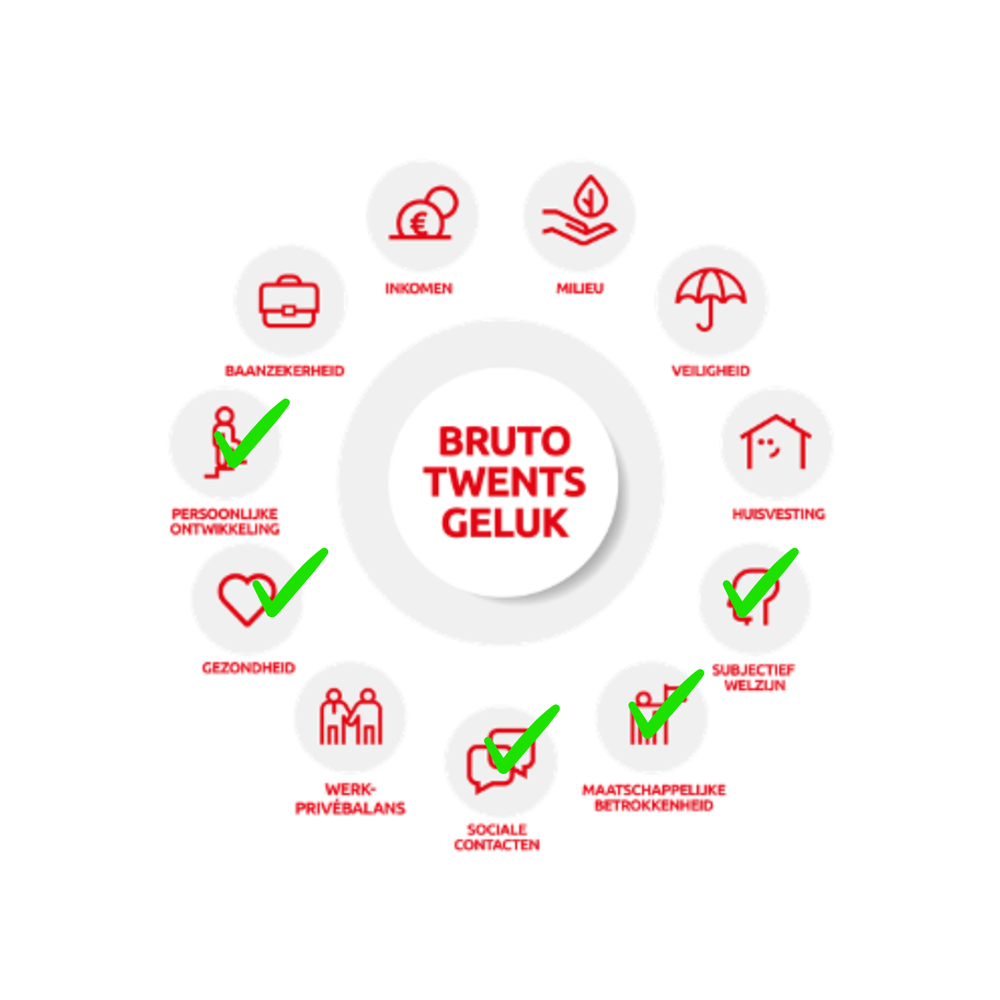
Gross Twents Happiness
Which indicators does the The Informal Care Collaboration project contribute to?
✓ Health
✓ Social contacts
✓ Personal development
✓ Subjective well-being
✓ Community engagement