

Healthcare Innovation Hub
More than half of the residents of Twente have one or more chronic conditions, and this number will continue to rise in the years to come. Meanwhile, healthcare is rapidly reaching its limits, with an ever-increasing shortage of personnel. Healthcare will have to be organized differently in order to keep care accessible for people with chronic conditions. Technology offers opportunities to make this change possible. However, technological healthcare innovations are often underutilized, and many innovations never make it into practice. The Healthcare Innovation Hub wants to change that. It brings together promising healthcare innovations by matching the needs of people with chronic conditions and healthcare organizations with the ideas and products of knowledge institutions and companies.
“Reuma is naast diabetes type 2, hart- en vaatziekten en dementie een van de chronische aandoeningen waar in Twente grote uitdagingen liggen en waar het Zorg Innovatie Plein zich dus op richt”, vertellen Renske van Wijk en Marloes Makkink, beiden werkzaam bij het TechMed Centre van de Universiteit Twente en Helga Blauw, van Medisch Spectrum Twente. Gezamenlijk coördineerden zij de aanvraag voor het Zorg Innovatie Plein als Regio Deal Twente project.
“In de huidige zorg ziet de reumatoloog een patiënt met reuma twee keer per jaar op vooraf geplande momenten. Er is geen inzicht bij de reumatoloog hoe het met de patiënt gaat tussen deze afspraken door. Door de inzet van laagdrempelige, toegankelijke technologie, kunnen symptomen inzichtelijk worden gemaakt in de thuissituatie. Hierdoor krijgen patiënten en zorgverleners meer kennis over en daarmee grip op het verloop van de aandoening. Zorg kan dan op het juiste moment en op de juiste plek gegeven worden, met ondersteuning van technologie. Dit draagt niet alleen bij aan minder zorgvraag, maar kan mogelijk ook opvlamming en blijvende schade voorkomen”.
Co-creation
“Alongside type 2 diabetes, cardiovascular disease, and dementia, rheumatism is one of the chronic conditions that pose major challenges in Twente and which the Care Innovation Hub is therefore focusing on,” explain Renske van Wijk and Marloes Makkink, both of whom work at the TechMed Centre at the University of Twente, and Helga Blauw, from Medisch Spectrum Twente. Together, they coordinated the application for the Care Innovation Hub as a Regio Deal Twente project.
"In the current healthcare system, rheumatologists see patients with rheumatism twice a year at pre-planned times. Rheumatologists have no insight into how patients are doing between these appointments. Through the use of low-threshold, accessible technology, symptoms can be monitored in the home situation. This gives patients and healthcare providers more knowledge about and therefore control over the course of the condition. Care can then be provided at the right time and in the right place, with the support of technology. This not only contributes to a reduction in the demand for care, but may also prevent flare-ups and permanent damage.
Method and results
The Healthcare Innovation Hub method consists of successively stimulating, assessing, guiding, and evaluating innovations. “A core team of people from the healthcare sector, knowledge institutions, patient groups, and the business community takes a critical look at innovations,” says Renske. “We look at the innovation from different angles. What is the impact on the accessibility of healthcare, how does it benefit the region and its residents? How does it fit into the healthcare process? Where are the opportunities for the business community? We are critical in this regard; we want to devote our time and resources to promising and feasible solutions for the accessibility of healthcare,” says Renske.
"We actively identify issues and opportunities, offer advice, support, or referrals, both in the early and late stages of healthcare innovation. If the focus is on technological development, we assess whether this innovation meets the needs of people with chronic conditions and/or healthcare institutions. In a later phase, we focus more on providing support for questions that arise before it can be applied in practice,“ says Marloes. ”For example, we look at training and developing the skills and (technology) competencies of professionals who will be working with it in practice."
The result of this project is the Care Innovation Hub, a central location and starting point in the region for innovations related to chronic conditions, where various stakeholders, ideas, and products are brought together.
Use cases
This project applies the principle of ‘learning by doing’: specific healthcare innovation processes (use cases) are used to set up and further develop a joint regional approach to promoting, assessing, supervising, and evaluating innovations. One of the use cases concerns innovation in the care of diabetic feet.
“Foot ulcers (open wounds that heal poorly) are a common complication in people with diabetes,” says Helga. "In almost a quarter of these cases, this leads to some form of amputation. Foot wounds therefore require a lot of care, such as wound nursing, treatment of infections, pain relief, home care, or surgery. In this use case, a smart bath mat is being developed that can be used to identify and prevent foot wounds at an early stage in the home environment. The patient uses the bath mat daily, while AI is used to check the feet for wounds. The healthcare provider is alerted in case of abnormalities. In order to create a product that fits in the home environment and within healthcare practice, it is important that the patient and the various healthcare providers are involved in the development and implementation of this innovation. The business community must also be involved in the development of this technology. We support that process in this project."
Collaboration
Nine parties are currently collaborating on this project: Deventer Hospital, Saxion University of Applied Sciences, Medisch Spectrum Twente, MedTech Twente 2030, ROC van Twente, Roessingh Rehabilitation Center, TZA Twente, University of Twente, and Ziekenhuisgroep Twente.
Want to know more?
Please contact:
Renske van Wijk, External Collaboration Coordinator, TechMed Centre, University of Twente
Marloes Makkink, Project Manager, TechMed Centre, University of Twente
Helga Blauw, Department Manager, Science Office, Medisch Spectrum Twente
T: 053 - 48 95 770
M: zorginnovatieplein@utwente.nl
Learn more about Healthcare Innovation Hub
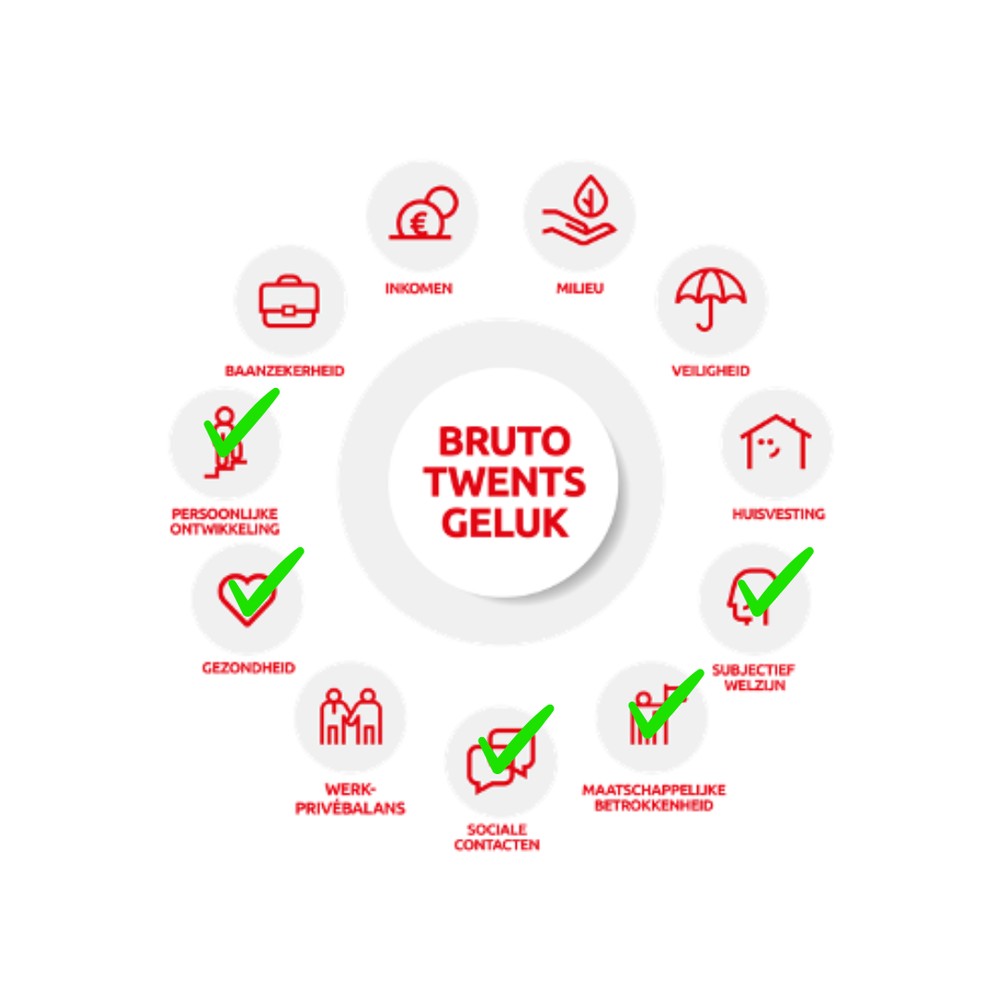
Gross Twents Happiness
Which indicators does the Healthcare Innovation Hub project contribute to?
✓ Health
✓ Subjective well-being
✓ Personal development
✓ Social contacts
✓ Community engagement