Twente strengthens its MedTech ecosystem with new innovations for medication development
Twente is continuing to build on its position as a leading region for medical technology. Two innovative projects for drug development have been awarded to the UT-TNO Joint Innovation Centre BIO/MicroSystems. The projects strengthen the collaboration between the University of Twente (UT), TNO and businesses, and contribute to the further development of Twente’s MedTech ecosystem.
With the support of the Twente Board, the University of Twente (UT), TNO and various companies are working within these projects to develop new technologies for more reliable drug development. This collaboration forms part of a broader investment programme designed to strengthen the partnership between UT and TNO and to further expand Twente’s MedTech ecosystem. In Twente, research, technology development and entrepreneurship come together to develop solutions for the healthcare of tomorrow.
Date of Publication: 23 September 2026
Read time +/- 6.0 minutes
From research to application
Pressure on the healthcare sector is mounting due to an ageing population, staff shortages and rising demand for care. Innovations that accelerate drug development and make it more reliable are therefore of growing importance. Within this context, the University of Twente (UT) and TNO play a key role by bringing together fundamental research, technology development and market-driven innovation. Through the Bio/MicroSystems Centre (B/MSC), researchers, technology developers and companies are working on microphysiological systems: miniature models of human tissue and organs developed on a micro-scale.
These so-called ‘organ-on-a-chip’ technologies mimic parts of the human body and make it possible to better predict how medicines and treatments will work in humans. Interest in this technology is growing worldwide because it can contribute to more reliable, human-relevant and animal-free testing methods for drug development.
B/MSC brings together expertise in the fields of life sciences, materials, microtechnology and advanced manufacturing techniques.
More reliable drug testing using human mini-organs on a chip
GALLOP: automatic measurement is knowledge
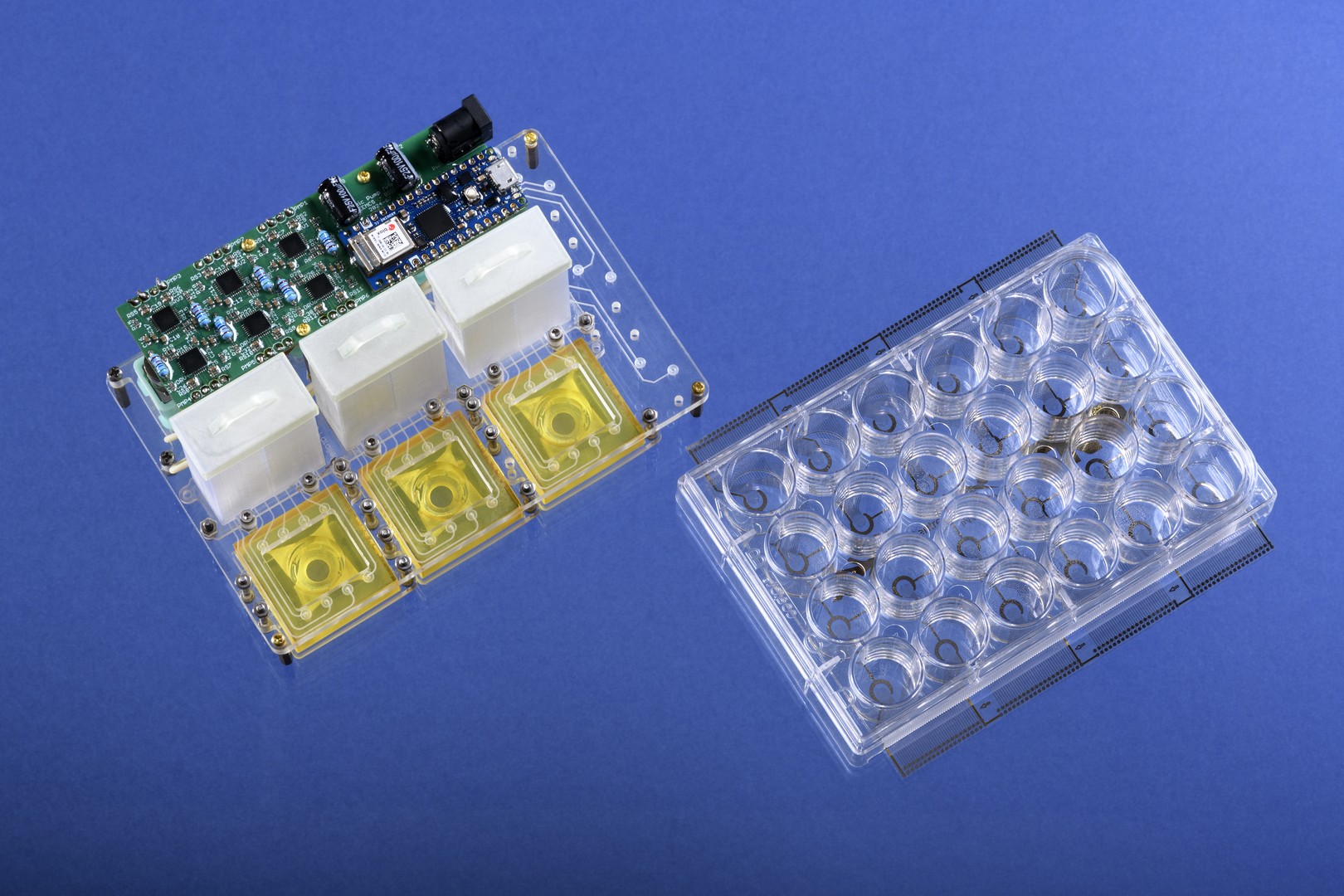
In the GALLOP project, B/MSC is collaborating with Demcon Life Sciences & Health to automate measurements in microphysiological systems. At present, many procedures – such as collecting fluids or small samples of cells or tissue – are often carried out manually and only at a limited number of time points. This takes time and can lead to variations in measurement results. By automating these processes and carrying them out on a micro-scale, researchers can take measurements more frequently, more quickly and with greater accuracy, without disrupting the growing cells and tissues. This provides greater insight into what is happening within the organ-on-chip model and when, and allows for better adjustments to be made where necessary.
This project combines the expertise of UT, TNO and Demcon to demonstrate a prototype of an integrated measurement and analysis system on a miniature scale. Ultimately, this system can be further developed to provide a detailed picture of biomolecular processes in a scalable and automated manner.
LIPOSMART: a smart substrate
Within the LIPOSMART project, B/MSC, Lipocoat, Bondus and the Swiss partner InSphero are working on new micro-lab plates and smart coatings for microphysiological systems. These form the basis on which cells grow and on which medicines are tested.
A major problem in pharmaceutical research is that certain medicines adhere to standard plastic materials. It is also difficult to keep small three-dimensional tissue models in place. This can make test results less reliable. LIPOSMART is therefore developing coatings that reduce unwanted interactions between cells, drugs and materials, whilst ensuring that miniature tissues remain securely in place. This creates a more stable and reliable testing system for research into new drugs.
The project will deliver a validated prototype that is being tested in a liver model. In addition, work is being carried out to develop knowledge regarding scalable production and future market launch. Furthermore, thanks to InSphero’s involvement, requirements from the pharmaceutical market are being incorporated right from the development stage, ensuring that the technology meets the needs of future users.
Building blocks for a stronger MedTech ecosystem
Through this and several other innovative projects and collaborations, B/MSC is strengthening Twente’s position in the field of microfluidics and organ-on-chip technology and forms a building block within the broader MedTech ecosystem. In doing so, the projects link the knowledge of the University of Twente (UT) and TNO with the expertise of companies in the fields of smart technology, biomedicine, manufacturing and market application.
The knowledge, technology and collaborative relationships developed contribute to new product opportunities, business activity and economic growth in the region. At the same time, B/MSC aligns with national developments within the Life Sciences & Health Top Sector, in which human-relevant testing methods and organ-on-chip technology are key themes. The projects generate new knowledge and technology, whilst also strengthening collaboration between research institutions and businesses. This creates new opportunities for innovation, economic activity and high-quality employment in Twente.
Wendy van Til
Twente Board
Share article on: